
47′ Friaça, 1-0
66′ Schiaffino, 1-1
79′ Ghiggia, 1-2
The 1950 World Cup is memorable: It was the first in over twelve years (a war nixed 1942 and 1946). Italy, winners in 1934 and 1938, were eliminated in the first round. The winner was decided in a group stage tournament. And the United States bested England 1 to 0 in front of 10,000 fans.
There’s more, of course.
Today, the listed capacity for the Maracanã Stadium is 78,838. But on July 16th, a record 200,000 fans jostled elbows to watch Brazil’s inevitable victory. They had already inscribed the names of players into the gold medals, and the mayor even gave a celebratory speech before kickoff.
You, who have no rivals in the entire hemisphere. You, who will overcome any other competitor. You, who I already salute as victors.
Angelo Mendes de Moraes.
But then the unthinkable happened. Watch the goal here.
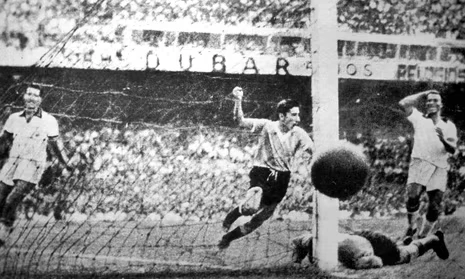

The defeat, known as the Maracanaço, devastated Brazil. It prompted the celebrated Brazilian playwright Nelson Rodrigues to write sixteen years later:
Everywhere has its irremediable national catastrophe, something like a Hiroshima. Our catastrophe, our Hiroshima, was the defeat by Uruguay in 1950.
The writer Carlos Heitor Cony described the experience at the game as a “collective orphaning.” Real orphaning may have happened. Several fans are rumored to have died of heart attacks during the game, and several more from suicide after.
Another hard defeat was waiting. After winning the World Cup in 1958, 1962, 1970, 1994, and 2002, Brazil lost to Germany 7 to 1 in the 2014 semi-finals.